Showing posts with label Boards. Show all posts

Thursday, January 10, 2013

Helping the Decision-Impaired Board

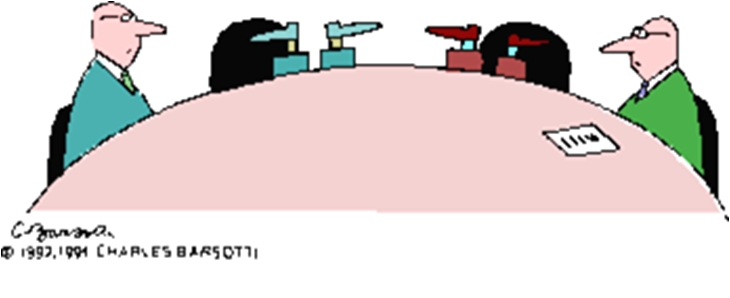
 "I think we qualify as a decision-impaired board!"

Is your board decision-impaired? You may recognize the symptoms:
  • A sense that the board is spinning its wheels and rehashing old issues.
  • Heated discussions based on few facts but lots of opinions.
  • Awkward moments when the board realizes it has lost track of the original topic.
  • The frequent introduction of “wildcard” issues which were not originally on the agenda.
  • An inability to explain to members why the board made a certain decision.
  • A decision is ostensibly agreed to by the entire board but in reality not supported by every board member.
  • A nagging feeling that decisions, when they are finally made, do not represent the best thinking of the board.
Is it possible for the decision-impaired board to improve? Take heart for the answer is yes. Let’s look at how to target a board’s competency in decision-making:

Step 1 – Self-Assessment: 
In order to improve, the board will first need a framework for understanding its overall strengths and weaknesses during group decision-making. It needs to answer three basic questions:
  1. How do individuals in the group prefer to make decisions, process information and set priorities? What are respective strengths and weaknesses of the individuals in the group?
  2. In what ways do these differences in individual styles lead to either to conflict or harmony among the board.
  3. What is the group’s overall strengths and weaknesses? Is there a balance of different decision-making styles or is the group top-heavy in one area but not another?
What is the best way to assess the board? The Leadership Spectrum Profile®. The profile identifies six types of priorities a person is likely to favor and how that priority influences his or her decision-making process:
 
 Leadership Spectrum Profile 

Priority
Actions
Inventor
Innovation and survival
Develop new ideas, products and services
Catalyst
Fast growth
Gain market share and win customers/new members
Developer
Manage risk and establish order
Build infrastructure, create systems and processes for high performance
Performer
Maximize results
Improve processes and procedures  for effective resource utilization and return
Protector
Maintain success
Develop committed workforce, build capabilities, & support culture/identity
Challenger
Position for the future

Surface assumptions, practices, and issues; and create strategic options
© 1998-2002. The Leadership Spectrum Profile®. Enterprise Management Ltd.  All Rights Reserved


Using the Leadership Spectrum profile, one decision-impaired board found all its board members were Challengers or Inventors.  From the standpoint of developing strategy, this was a definite plus, as the association needed to position itself for future.

From an operational standpoint, however, the board was very weak and this was reflected in its chronic inability to make timely and sound decisions. In fact, the association was in jeopardy due to financial difficulties. The board realized it had no individuals who were strong as Developers or Performers. As a consequence, the board paid little attention was paid to metrics for or processes to improve its performance. 

With this realization, it became clear why good decisions about operational issues were hard to come by. The board responded by saying, "Okay, when it comes to issues of performance and board development, we have to slow down, take the time to ask the types of questions a Developer or Performer might ask. In that way we can compensate for our weaknesses in those areas.”
To recap, using the Leadership Spectrum Profile provides a framework so the board understands how to:
  • Balance strategic and operational decisions.
  • Lead and implement change.
  • Develop credible and constructive communication practices.
  • Manage conflict and facilitate creative problem solving .
 
Step Two – Establish Guidelines for Effective Decision Making:

Once a board understands its strengths and weaknesses in decision-making, it needs a practical set of guidelines and processes. The following set of questions, which represents the steps to sound decision-making, are the basis for those guidelines.

IS THIS A BOARD PRIORITY? Is this issue a priority for the association and for the board? If so, why? Is the board meeting the best venue for addressing this issue? Or can it be addressed in another venue?
#
WHAT IS THE OBJECTIVE?  What is the goal or objective? What is the board trying to accomplish by making this decision? Have we clarified the problem or issue? What is the problem that really needs to be focused on? Does everyone agree we that we have a well-defined problem statement?
#
WHAT ARE THE FACTS? What's the situation or background? Does the board have all the facts it needs to begin the discussion or should we table the discussion until more information is gathered?
#
WHAT ARE THE DECISION OPTIONS? What are all the possible decision we might make? Which ones are most feasible or on-target?
#
WHAT ARE THE CRITERIA? Before we begin making a decision, have we identified and agreed to the criteria we will use to make our decision?
#
WHAT IS THE DECISION-MAKING PROCESS? Are we clear how the group will go about making a final decision? Is it consensus? Majority vote? Another methodology? 


Step Three – Practice!

It is not sufficient to ask the Board to read an article or provide a fifteen minute presentation on decision-making skills. This rarely improves board performance. The fastest, most effective path to improved decision-making is hands-on training; the Board should set aside time so it can practice – go through the process of applying specific skills and guidelines so they understand the practical applications and benefits. I have seen Boards, as a result of a day of practice, make dramatic improvements.

In conclusion, I would like emphasize the following: if you want to improve the decision-making capabilities of your board, you need to invest the time for skills training and hands-on practice.   


Thursday, May 19, 2011

What Do the Best Boards Believe?

What do the best boards of directors have in common? What common beliefs might they share? I was thinking of this as I read 12 Things Good Bosses Believe by Bob Sutton. He lists the following as key beliefs "that are held by the best bosses — and rejected, or more often simply never even thought about, by the worst bosses." 

  1. I have a flawed and incomplete understanding of what it feels like to work for me.
  2. My success — and that of my people — depends largely on being the master of obvious and mundane things, not on magical, obscure, or breakthrough ideas or methods. 
  3. Having ambitious and well-defined goals is important, but it is useless to think about them much. My job is to focus on the small wins that enable my people to make a little progress every day. 
  4. One of the most important, and most difficult, parts of my job is to strike the delicate balance between being too assertive and not assertive enough. 
  5. My job is to serve as a human shield, to protect my people from external intrusions, distractions, and idiocy of every stripe — and to avoid imposing my own idiocy on them as well. 
  6. I strive to be confident enough to convince people that I am in charge, but humble enough to realize that I am often going to be wrong.
  7. I aim to fight as if I am right, and listen as if I am wrong — and to teach my people to do the same thing.
  8. One of the best tests of my leadership — and my organization — is "what happens after people make a mistake?"
  9. Innovation is crucial to every team and organization. So my job is to encourage my people to generate and test all kinds of new ideas. But it is also my job to help them kill off all the bad ideas we generate, and most of the good ideas, too. 
  10. Bad is stronger than good. It is more important to eliminate the negative than to accentuate the positive.
  11. How I do things is as important as what I do. 
  12. Because I wield power over others, I am at great risk of acting like an insensitive jerk — and not realizing it.

Which beliefs do the best boards embrace?

Think about what makes for a great board, then look over the above list and ask yourself, "Which of these twelve beliefs are most likely to be embraced by the best boards?"   I contend items # 8, 10 and 12 deserve to be at the top of the list because the best boards:
  • Are able to respond, in a mature, non-scapegoating fashion, when mistakes occur.
  • Realize their ability to do bad is greater than their ability to do good.
  • Are cognizant of how much power they wield and realize, accordingly, that might doesn't make for right decisions.
What do you think?

Wednesday, March 2, 2011

The Decision-Impaired Board

"It appears we need a better way to make decisions..."

Boards – not to mention committees, task forces and almost any group –  often struggle when it comes to decision-making. Here are two helpful questions to ask:

1.  Is this decision “Board Worthy?”

“Congratulations, in the last five hours we've made three important decisions affecting the future of our organization:
  • What hors d'Å“uvres to serve at the next Board meeting.
  • That Garamond will be the official font for all brochures.
  • We'll put something to do with that 'strategy thing' on the next agenda, time permitting."

Alas, the situation depicted above is all too familiar! Countless issues, both trivial and irrelevant, are brought before the board; issues that could and should have been decided by someone else. So ask yourself: does my organization have a clear set of criteria by which to evaluate what issues should (or should not) be decided by the board? (Suggestion: If you don’t, I would put that on my “to do” list).

2.  Can we use a task group? Or delegate?

Some decisions require the entire board's involvement, from the initial discussions and fact gathering to the final vote. However, not all decisions require that level of involvement. Often, boards fail to take advantage of these two options:

 Sometimes a task group should be used to do the "advance"
work, researching the topic and making a
recommendation for consideration by the entire board.


Other times, the board should delegate the
decision-making to a committee or the staff.


'nuff said!

Recommended reading; Stop Wasting Valuable Time
Recommended workshop: Decision Making Workshop.

Wednesday, January 12, 2011

Ground Rules for Board, Volunteers and Staff

In an earlier post, Building Trust between Board and Staff, I discussed the need to develop and  invoke a set of ground rules to promote trust between volunteers and staff. Listed below are ten rules for your consideration:

Volunteers - Staff Relationship Ground Rules

  1. Our number one purpose is to serve our members to the best of our abilities. All of our actions, priorities and words must be judged against that. Therefore, we conduct every board or committee meeting as if the entire membership is watching. We ask ourselves: would our members be proud of how we have conducted ourselves?
  2.  We seek to gather all the facts before entering into a discussion or making a decision. We acknowledge that the quality of our actions and decisions are only as good as the quality of our knowledge about the situation.
  3.  We believe in accountability, not blame. We acknowledge that mistakes and failures will occur and    we will use these as learning opportunities.
  4.  When a mistakes or failures occur, we remind ourselves of rule #1.
  5.  We work hard to catch each other doing the right thing. We will celebrate our successes.
  6.  Hidden agendas and gossip are forbidden.
  7.  Each of us agrees to listen with full attention when another person speaks.
  8.  Volunteers will ask the staff: What is the impact of our decision(s) on you? Have we listened to your perspective and wisdom about the implications of this?    
  9.  When the staff brings forth an item for decision-making to the volunteers they will ask: Have we explained this clearly? Do you feel you have enough information with which to make a good decision? Have we listened to and addressed the big questions you have raised?
  10. Every person takes responsibility for the successful outcome of a meeting or interaction. These   ground rules can be invoked by anyone whenever necessary.

Wednesday, January 5, 2011

Building Trust between Board and Staff


Trust is the fundamental quality of successful, productive and sustainable relationships. Without trust between the board and staff, an association’s ability to serve its members suffers. This leads to the logical question, how can the executive approach, in a systematic manner, the challenge of building trust to achieve performance?

Here are some facts to consider:
  • Ninety-one percent of employees rated “being trusted to get the job done” as the most important thing to them in their work setting (2001 Randstad North American Employee Review)
  • A Watson Wyatt Worldwide survey found only half of employees trusted senior management.
  • Watson Wyatt also found that in terms of performance, companies where employees trusted top executives posted shareholder returns 42% higher than companies where distrust was the rule.
While I know of no research that documents relationship between trust and performance in associations, I have no doubt there is a close correlation. The following shows the differences between two organizations, one with high degrees of fear and distrust versus one where the culture is built on a foundation of trust.


Culture of Distrust and Fear
Culture Built on Trust
Minimal collaboration
High levels of collaboration
Turf Battles
Open Sharing of Information
Low Morale
High Morale
Negative Gossip
Positive Gossip
Ridicule
Respect
Low levels of innovation
High Levels of Innovation
Crisis
Anticipation
Sabotage/Behind the Back Gossip
Disciplined Communications

As I look over the left-hand column there is an air of familiarity about it. Sad to say, many of the behaviors in left hand column are all too common in the realm of board-staff relationships.

Awhile ago, I had the opportunity to work with Bob Foxworthy, a consultant who has developed an approach he calls Trust-Based Leadership™.  His work with companies such as Tropicana, CSX and Hewlett-Packard has won awards such as the George Land Leadership 2000, World-Class Innovation Award and Rail Business Magazine’s Railroad-Shipper Win-Win Award for customer-supplier collaboration.

My experience working with him on a leadership training program for a police department in Virginia opened my eyes to techniques and approaches that can be used by associations.  Here are three ideas I would like to throw out for your consideration.


Idea #1: Develop and invoke a set of ground rules to build trust

Ground rules are a way to clarify and codify the answer to four questions:
  • How do you want to be treated?
  • How do you think you should treat others?
  • How do others think you want to be treated?
  • How will we resolve conflicts?
Unfortunately, most associations have no ground rules to guide the relationship between board and staff.  And those with ground rules seem to pay them lip service. If people in an organization cannot answer the four questions above, they will seriously constrained in the ability to achieve improved levels of performance.


Idea #2: Develop a Set of Measurements

There is a maxim that whatever you measure, you get more of. So, if you want board and staff to be clearer about their roles, do a better job of communicating,  be more active in sharing information and work together for a  common goal – then it makes sense to have a way to measure those things. Here are some indicators you might use to measure trust in your association:
  • Clarity of roles: Are the roles of board members and staff clearly defined?
  • Communication: Are the lines of communication and process for communication between board and staff clearly understood by all?
  • Open sharing of information: How well do board and staff share information vital to making sound decisions?
  • Shared Purpose: To what extent do board and staff feel they are working towards to the same set of goals?
It is worth emphasizing the importance of measurements. You can and should measure the factors that shape trust in your association. Doing so allows you monitor what is happening, pinpoint “trust fractures” and take corrective action.


Idea #3: Have an annual game plan

Trust is a perpetual process that must be continually renewed among people and within organizations. Many times I have heard an executive say something like this: “When I was first hired five years ago the board knew and trusted me. But now, due the turnover, I feel they no longer trust me.”
With this mind, an executive director should have a game plan each year designed to build and maintain trust between the board and staff.  Asking the following questions will help you develop the game plan:
  • Are we invoking the ground rules for board-staff relationships? Do new board members (and new staff) have the opportunity to explore and discover why the ground rules are important?
  • Are we measuring and monitoring key indicators of trust? Am I using those measurements to facilitate better communication and collaboration?
  • Am I paying attention to my personal leadership and communication styles. Are there aspects I need to change or new skills I need to learn to become more proficient at creating an environment of trust?
Finally, I would like to share, courtesy of Bob Foxworthy, seven characteristics of Trust-Based Leaders:
  1. They work to build trust with others in all they do.
  2. They demonstrate humility and authenticity when interacting with others.
  3. They tell the truth to their peers and their followers, even when it is personally painful to do so.
  4. They are open, honest and direct in their communications.
  5. The demonstrate respect to others.
  6. They consistently act in an ethical manner.
  7. They are courageous visionaries committed to becoming the best that they can be and /or leading their organization to greatness (measurably defined).