Showing posts with label strategic planning. Show all posts

Thursday, April 5, 2012

Tuesday, April 3, 2012

Put Your Strategic Plan to Work!

In these tough economic times, it is vital to get the most out of your strategic plan. That's why I am pleased to present, Put Your Strategic Plan to Work!


PUT YOUR
STRATEGIC PLAN
TO WORK!


Rally your volunteers and staff  around a focused set of goals!


When to Use this Service:
  • To get the most out of your plan in these tough economic times.
  • To help incoming board members, volunteers or new staff get up to speed.
  • When momentum and enthusiasm for the plan may have stalled.
  • To brainstorm solutions when unexpected obstacles arise.

Delivered in the Format that
Meets Your Association's Needs

Each session is customized specifically for your association. I work closely with you to determine the needs of your board, committee and staff. The format is flexible to accommodate your schedule. For example,  Put Your Strategic Plan to Work can be:
  • Scheduled as a follow-up to your Board's strategic planning session.
  • Presented as the basis for a Board or staff retreat.
  • Offered as an educational workshop for your chapters or committees.
  • Designed as a series of hands-on working sessions for your staff.
    Each session of Put Your Strategic Plan to Work addresses the three challenges an association typically faces when implementing its strategic plan: Action Planning, Productive Collaboration and Priority Setting.


    Action Planning

    Participants dive into the in hands-on creation of hit-the- ground-running action plans. This includes:

    Identifying crucial steps: The key actions that must be taken in the coming months or year.

    Overcoming obstacles: Determine those issues most likely to derail implementation of the plan; utilize problem-solving techniques to overcome those obstacles.

    Defining task assignments: Determine who does what by when. This helps to ensure accountability.

    Developing clear, understandable measurements: To ensure the plan stays on track and everyone agrees how to monitor progress.


    Productive Collaboration
    Between Board and Staff


    This section covers three topics:

    Defining roles and responsibilities for volunteers and staff: To overcome the common problem that results when there is a lack of clear role delineation between board and staff.

    Communicating the plan: An ongoing, internal marketing campaign to promote the strategic plan ensures that volunteers, members and staff are fully educated about the strategy.

    Leadership styles and buy-in: Putting your strategic plan to work requires "buy-in" from volunteers and staff. To assist you in this challenging area of leadership, the session reviews the most effective leadership styles and priority setting styles along with practical ways to apply these to your association's situation.


    Priority Setting:
    Allocate Your Resources Productively

    This segment addresses two critical questions:

    Allocation: During the coming year, what is the most productive way to allocate our association's limited resources? What will give us the most bang for the buck?

    Leveraging: Can we identify creative approaches to achieve maximum leverage from our limited resources?


    For more information,
    feel free to contact me at: Allen@GetALiff.com
    Click here for more articles on Strategic Planning.                                                                                                                       


    Wednesday, April 27, 2011

    Two Common Pitfalls of Strategic Planning

     
    What ails your strategy? After all the time and effort - not to mention the costs associated with the ordeal - you end up with a strategic plan that that seems to have little or no impact. What to do? Here are two common pitfalls to avoid that will help you put your strategic plan to work.

    Pitfall: Losing Sight of the Member

    Because strategy creation is a complex, drawn-out affair, it is distressingly easy to lose sight of what matters most: the member. Discussions about factors such as competition, demographic or social trends, and technology are essential to the process. Unfortunately, many associations fail to link this discussion to the factors that will impact the lives of their members.

    The result is often a nice sounding but rather meaningless statement such as, "Our association will be a leader in utilizing Social Media to connect and empower members."  Compare that to a statement such as, "Within the next three years we will connect at least two-thirds of our members via Social Media applications. With this platform in place, we will be able to deliver a greater variety of higher quality education programs at a lower cost. It will also make it possible for prospective members to "test drive" the membership experience (which will directly support our goal of increasing membership levels by 15% in the next four years)..."

    The first statement promises nothing of value. The second statement, in contrast, makes a simple, direct, and compelling link to the how and why of getting and keeping members.

    Pitfall: Losing Sight of Goals Deserving of One's Time and Commitment

    Strategic plans are often greeted with little enthusiasm by staff and volunteers because the long-term benefits are not obvious; it is difficult to see any direct relevance to the day-to-day activities of the organization. Is it any wonder, therefore, that the following scenario is played out in countless associations across the nation? During a meeting someone asks, "How does that relate to the long-range plan? And by the way, what are the main goals of the plan?" Suddenly, everyone else in the room is uncomfortable as they frantically search for a copy of the plan.

    The moral? The strategic plan has become an irrelevant, benign document. It has little, if any, impact on  how the staff or the board behaves and ultimately no impact on the lives of the members. The challenge, therefore, is not only to create strategy but to make sure it "sticks" to the organization. Toward that end, a successful strategy must, as noted by the likes of Theodore Levitt and others:
    • express itself simply and clearly in only a few written lines;
    • establish truly worthwhile goals so that people will march to its tune; and
    • set short-term targets that deserve the time and commitment of staff and volunteers.


    Wednesday, December 1, 2010

    I told the Board, "Your strategic plan is shallow and vapid!"

    I stood before the Board of Directors, their strategic planning document in my hand, and said, “Quite frankly, this is shallow and vapid.”  Then, with a dramatic flourish, I threw their cherished strategy on the floor.

    What the in the name of Section 501(c) of the United States Internal Revenue Code was I doing?

    It all began as I prepared to facilitate my client’s upcoming board meeting. As I read their strategic plan I became increasingly detached; the discussion of mission, goals and tactics seemed lacking somehow. I felt much like the fellow below:


    It was a much different situation, however, when I finally met the Board and asked them to talk about their hopes and aspirations for their association. It was exciting to listen as they talked about the stakes of succeeding, what the association could achieve in ten years.

     THE “MISSION, GOALS, TACTICS” DISCONNECT

    The problem: The written plan captured none of the excitement I felt during my discussion with the Board. I realized that tired old format of mission, goals and tactics wasn’t cutting it; it read more like a laundry list of things to do rather than a focused set of decisions. And this was a huge problem because the written plan was the main tool for communicating the strategy.  No wonder most of the staff and members were unenthusiastic. No wonder the board was having trouble getting buy-in and support!

    At this point, you might be wondering what happened after I declared their plan “shallow and vapid” and threw the document on the floor. Well, there was that long and uncomfortable silence. Then, with a rueful smile, the President said, “Shallow and vapid? You know, my wife often says that about me.”  That bit of humor broke the ice, the board understood. We then moved on to the fundamentals: how to talk about strategy so staff and members understand what it is happening, its importance and are more likely to be enthusiastic supporters.

    THREE STEPS TO GETTING PAST THE TEDIUM OF MISSION, GOALS AND STRATEGY

    1. Start by using the, “We must__, so that___” statement.

    A Board and the Executive should be able to articulate the essential core of their strategy with a statement such as: “During the coming year WE MUST (take a specific action leading to a positive result).  We’re doing this SO THAT a (benefit of strategic importance is realized).

    If you are unable to explain it this succinctly, if you can’t convey what’s at stakes for your members, your strategy won’t inspire anyone and it won’t make much of a difference in the long-run.

    2. Identify where to “hit-the-ground-running.

    If you want to mobilize staff and volunteers in support of the strategy, don’t hand them a list of tactics. Instead, have them identify those activities which meet two criteria: 1) They will have an IMPACT (i.e., contribute in a meaningful way towards the plan); and 2) They are FEASIBLE (i.e., the association has the resources, staff, skills, etc. to make it happen).

    In other words, you are identifying activities that helps the association "hit-the-ground-running." The Impact/Feasibility Grid is an excellent tool for identifying such activities; those fitting in the upper right hand corner represent activities where your association can hit-the-ground-running.


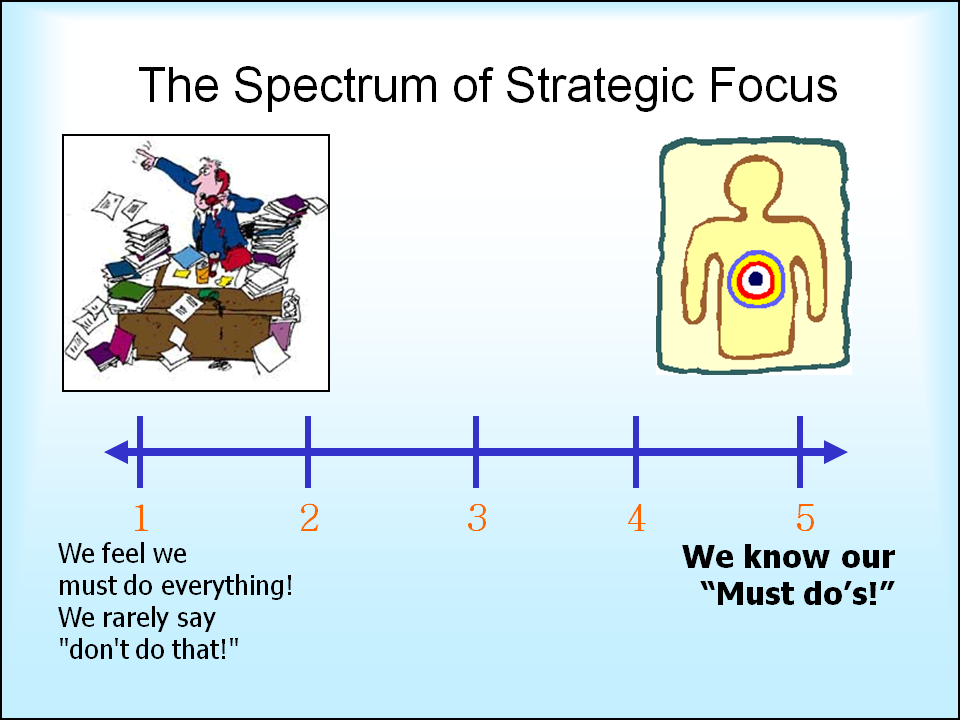
    3. Get Serious About Setting Priorities.

    On a scale of 1-to-5, where is your association? 


    It’s all too easy to argue that an association has many things on their plate, thereby making excuses about the difficulties of setting priorities. However, there is no escaping this simple fact: a strategy represents a set of decisions about the future, about what to do and what NOT to do.

    The Board and Executive who are unwilling to make tough decisions or support efforts to take marginal programs off the plate end up having no credibility when they talk about strategy and priorities.  

    'nuff said!

    Tuesday, November 16, 2010

    Your Strategic Plan is Useless

    Those are the words of Dwight D. Eisenhower, a five-star general in the United States Army and the 34th President of the United States.

    “Argh!,” you might be screaming, “are you telling me that my organization’s strategic plan is useless? Not to mention our marketing plans and other plans? Did we waste a lot of time and money on something worthless?” Despair not! Let’s take a closer look at what is going on.

    “Plan” is a noun.

    Eisenhower is saying that plans (i.e., a noun, a thing) is useless. You know what? That makes a lot of sense. Nine times out ten, it seems, the plan is little more than a written document (i.e., a "thing) that gets put aside:


    “Planning” is a verb

    How can you convert a useless plan into something worthwhile? How can you put it to work? Let’s go back to what General Eisenhower had to say about plans. Here is the complete sentence:
    Ah, what a difference a verb makes!” Notice the emphasis on the verb, on action! In other words, the situation isn't so hopeless!  You can take your written plan and actually do something with it: here is a step-by-by process you can use to engage staff and volunteers:


    Begin by asking staff and volunteers how much they understand about the plan.

    Find out what questions and concerns they have about the plan.

    Make your best case for how the plan will make a
    meaningful difference in the lives of your members.

    Make sure you get a reality check about the feasibility
    of the plan by asking about implementation issues.

    Find out where your staff and volunteers stand.
    Are they ready to support the plan? If not, find out why!


    Put the emphasis on action! Ask staff and volunteers,
    "how do we hit the ground running with this?"

    So, what's happening with your strategic plan? Isn't time to put it to work?