Showing posts with label associations. Show all posts

Thursday, June 23, 2011

Three Reasons Your Chapters and Volunteers May Not Trust You

Are you trustworthy? Do your volunteers and chapters see you as sincere, reliable and involved with them?  “Of course!” you respond. “The staff at HQ strives for professionalism and to earn the trust of volunteers and chapters each time we interact with them.”

Let us now ask this in a slightly different way: Given the context of their daily life experiences, what might create the perception, in the mind of a volunteer or chapter executive, that you, or another staff at HQ, are not trustworthy?

To answer this, I will present three examples, utilizing snippets from a day-in-the-life of a volunteer or chapter executive, to illustrate how trust can be unintentionally undermined.


Why Jane doubts your sincerity

Jane is the chapter executive for the Terabitha Chapter (which is famous for its annual bridge building contest). On Tuesday morning, she called customer support about a software issue.  After numerous rings, her call was put on hold with a message that began, “Due to high call volume…” and concluded with, “…your call is very important to us.”

“My call is important? Do you sincerely expect me to believe that?” Jane muttered to herself.

That afternoon, she called to find out about a major policy change under consideration by the national Board.  Local members were concerned and she had been trying, for the past week, via email and unanswered calls, to get more information. Finally, she gets you on the phone and you tell her, “I sincerely apologize for not getting back sooner, we’ve had a zillion calls about this policy issue…”  Jane mutters under her breath, “yeah, due to high call volume.”

You hear the agitation in Jane’s voice so you try to reassure her, “Jane, I value your opinion as I do all the chapter executives.” At that moment, Jane is having a wicked bad flashback to her earlier call: all she hears is, “your call is very important to us.”

Jane, for easily understandable reasons, begins to doubt if anyone at HQ sincerely cares about her opinion.


Why Hank thinks you are not reliable
 
Hank is a volunteer with the Hyboria Chapter and serves as the Chair of the National Membership Committee. Wednesday morning, he has a doctor’s appointment scheduled for 11:30. He knows, from prior experiences, the doctor won’t actually see him at 11:30. It will be more like 11:54 or sometime after noon. As he sits in the waiting room, rereading the July/1995 edition of Sports Illustrated for the 37th time, he recalls how, last week, the cable guy showed up 90 minutes late. “People aren’t reliable,” he thinks to himself.

That afternoon, he checks his email. You had promised him the agenda and support documents for the upcoming committee meeting by COB of that day. He calls and you apologize. You go on to explain, “The materials are almost ready. Unfortunately, there was an urgent request from a Board member yesterday – high priority – so I was pulled in to work on that. I will have your materials to you no later than tomorrow afternoon.”  That night, you work late so you can deliver the materials first thing in the morning.  It was delivered late, but heck, it was just a little bit late. Under the circumstances, you feel okay about that.

Hank, meanwhile, has mentally put you into the same category as his doctor and the cable guy. “HQ staff aren’t reliable,” he thinks to himself.


Why Harmon thinks you are not involved with him

Harmon is the new staff exec at the Narnia chapter. It is his first job in associations, a lot of issues and problems are brand new to him.

Friday morning, he drops his car off for repairs. He has a new mechanic, Sal, who was recommended by a neighbor who said, “I totally trust him.” Sal greets Harmon and says, “tell me everything you can think of about the problem.” He listens without interrupting. Then he starts asking questions,  lot of questions. Finally, he says, “Chances are it is one of two issues. The only way I can be sure is if…”

That afternoon, Harmon picks up his car – it runs perfectly. He reflects on Sal’s ability to listen, and realizes it is the ability to ask lots of questions, the process of getting involved,  that makes Sal a good mechanic. That’s why his neighbor trusts him completely.

Meanwhile, Harmon has been struggling to get up to speed on association type issues. He calls you for advice and begins the conversation by unloading all the background details. You realize his questions can be easily answered with a series of FAQs you have written. Besides, your schedule is packed and you conclude that a long conversation with Harmon is not the most efficient use of your time. You politely cut the conversation short, directing Harmon to the FAQs. You  hang up, rush to your meeting, thinking, “It would have been nice to chat, but that’s why we have FAQs…”

Harmon, meanwhile, is comparing his experience with you to the conversation he had with Sal the Mechanic. Unlike Sal, you didn’t bother to ask a lot questions, you didn’t take the time to get involved.  Harmon shakes his head and realizes he’d rather talk to his mechanic than to you. He picks up the phone, makes a call and says, “Hey Sal, what do you know about associations?”

The Bottom Line: To build trust with another human being, you need to consider the context of that person’s daily life. Everyday, your volunteers and chapter executives encounter and assess the trustworthy of a variety of people. Those experiences create a filter through which they learn to trust, or distrust, others…and that includes you. The more you understand their context for assessing trust, the more success you will have.

Tuesday, May 3, 2011

Could a Five-Minute Interaction with Members Boost Staff Productivity?

An intriguing question, eh? It came to mind after reading, Putting a Face to a Name: The Art of Motivating Employees

The article discusses a study involving paid employees at a call center for a public university; their duties included phoning potential donors to the school. As the authors note, "Employees...suffer frequent rejections from people unhappy about getting calls during dinner. Turnover is high and morale is often low. So how do you motivate workers to stay on the phone and bring in the donations? One relatively easy answer: Introduce them to someone who is aided by those dollars."

The study arranged for a five-minute session, where the employees could meet and interact with scholarship students who were the recipients of the school's fundraising efforts. The results were impressive: employees who had interacted with the scholarship students brought in vastly more money: a weekly average of $503.22, up from $185.94.

And this raises the question: should associations use a similar tactic? What if your association arranged, on a regular basis, for every employee to have a five-minute interaction, in-person or by phone, with a member who has benefited in a significant way from their membership (i.e., a member who has a positive and powerful story to tell)

What might be the pay-off in terms of morale and productivity?  

Thursday, April 21, 2011

The "I Need..." Statement: An Engaging Technique for Stating Member Benefits

An earlier post, An Engaging Member Conversation, discussed the challenge of engaging new members and helping them find satisfying ways to participate in the association. 

With that in mind, let's take a look at the "I Need..." statement. Because it expresses, in the first person, what a potential member is seeking, it is a powerful communication technique. Consider the following presentation of member benefits, from the The Entrepreneurs' Organization:

Click on picture for full sized image


Three Simple Sentences!

The beauty of this approach is that, with three simple sentences, EO is able to sum up the value of its many programs and services:
  • I need to find other people like me; those who understand what it's like to own a business.
  • I need to solve business or personal challenges I haven't faced before. I'm walking in the dark here.
  • I need to expand my network, get out there and meet people who can help me grow.
 From a communications standpoint, this is one elegant solution!

The Power of the First-Person

Using the first-person voice echoes what goes on inside a prospective member's mind and engages on two levels. First, it offers the promise of a tangible benefit or solution. Second, it invokes a feeling of belonging, the prospective member is likely to think, "if other people with the same need have joined EO, this is probably the place for me!"

The Bottom-Line: There's an art to communication that engages members and prospects. The next time you examine your member benefits statement, try to boil it down to three simple sentences that begin with "I need..."

Friday, April 15, 2011

The Case of the Myopic Association

In a recent report, the Bureau of Labor Standards claims that over the next decade, ten types of industries will be deemed "no longer viable or profitable" and will see a steep decline in the number of people they employ. (Jobs That No Longer Exist: 10 Industries Heading for Extinction).  

Reading that article brought to mind an exercise I developed a number of years ago. It is called, "The Case of the Myopic Association" and was first published in the ASAE Foundation's publication, Embracing the Future. It uses an example from the 1930's involving the New Jersey Retail Grocers Association and their inability to prepare for the future. The exercise is reproduced below. (Click on the picture for a full-sized image).

Click on picture for full-sized image.

Tuesday, April 5, 2011

Want to Make Membership Everyone's Business? Call in the Marketing Subversives!


In two prior posts (What Would Tony Soprano Do? and Don't Tell Me Membership is Everyone's Business!), I discussed how to engage the entire staff of your association in the cause of membership. To further this cause, I will now discuss how to act as a Marketing Subversive.

The term comes from an article of the same name, Marketing Subversives (I highly recommend you download it). The author spent five years interviewing more than 1,000 managers in 30 companies. His goal was to understand how the certain managers were more successful in communicating and collaborating across departments and functions to achieve their marketing goals. Hmmm....seems to me some of these lessons might be useful in furthering an association's overall goal of recruitment, retention and member satisfaction.

Three Things Marketing Subversives Do

What is that subversives do? It comes down to three things:
  • They constantly work at organizing informal contacts among functions and departments?
  • They have a knack (or a charm or simply the persistence) for breaking through territorial defenses and organizational insularity.
  • They are savvy about knowing when and where to bend or break the rules.
The articles notes that "marketing subversives constantly analyze people's motivations" and seem to be constantly asking, "What do they really want?"  In other words, they are using a thinking process similar to that of the "Don't Sell Me ___, Sell Me ___" exercise discussed in Don't Tell Me Membership is Everyone's Business!

Furthermore, subversives build goodwill in their organizations by developing an exchange bank - "by doing favors for others,  they amass credits that can be traded for information or help." This is just another way of stating the principle of  "think cooperation and reciprocity" as outlined in What Would Tony Soprano Do?

The Bottom Line: Are you ready to become a marketing subversive?

Saturday, February 19, 2011

Innovation: Got Focus?


In two earlier posts (here and here) I proposed two of three questions executives should ask themselves before embarking on a crusade for innovation.  The third question, which concerns focus, is the topic of this article.

Got Focus?

Let’s start with a simple proposition: ninety percent of all managers lack the requisite focus to successfully implement an innovation initiative.

An article entitled, Beware the Busy Manager, offers important insights into what is going on. For ten years, the authors studied the behavior of busy managers, and their findings are instructive: fully 90% of managers squander their time in all sorts of ineffective activities. A mere 10% of managers spend their time in a committed, purposeful, and reflective manner (i.e., the purposefulness quadrant).

Managers that fall into the other quadrants, by contrast, are usually just spinning their wheels; some procrastinate, others feel no emotional connection to their work (disengaged), and still others are easily distracted from the task at hand. Although they look busy, they lack either the focus or the energy required for making any sort of meaningful change.

 The Bull in the China Shop

By far the largest group of managers found in the study—more than 40%—fell into the distracted quadrant: those well-intentioned, highly energetic but unfocused people who confuse frenetic motion with constructive action. When they’re under pressure, distracted managers feel a desperate need to do something—anything. That makes them as dangerous as the proverbial bull in a china shop.

 Got Credibility?

Which brings us to the bull in the cartoon, he lacks credibility. The poor store clerk is just wasting for the inevitable rampage.

Likewise, it is no wonder that most employees react with groans when management announces, “We’re doing innovation!”  That’s because most managers, and management teams. lack the focus to deliver. “Innovation” becomes just another flavor-of-the-month initiative, another euphemism – from the employees’ point-of-view –for spinning their wheels.

Now ask yourself, am I a focused manager? How about the rest of the management team in my organization? If we announced an innovation initiative, would we have any credibility?

Thursday, February 17, 2011

Learning to Create the Future

"Asking members what they want is stifling my ability to make a breakthrough!
 
"Does asking our members what they want stifle breakthroughs?"

That question was posted recently on the ASAE Executive Listserv. In response, I offer the following excerpt from an Association Management article printed way back in August, 1997!

Learning How to Create the Future

  “Companies that create the future do more than satisfy customers, they constantly amaze them.”
                                                Gary Hamel and C.K. Prahalad,  Competing for the Future

What will it take to constantly amaze your members into the future? That's a question every association executive needs to ask in this era of rising member expectations and increasing competition.

With that in mind, let us explore four lessons, learned from some of the most highly successful and imaginative corporations, that you can apply to your association's strategy-creation process.

Why is it that some organizations are capable of imagining and creating the future while others are forever playing catch up? The future-focused organizations have learned the following lessons.
 
Lesson 1: Imagination is the master of great strategy, implementation its servant.

If an organization wishes to create the future, it must begin by imagining compelling ways to amaze its customers. Then, and only then, should it ask, How will we do this? What are the details of implementation?

At first glance, this may seem a risky or unscientific approach. After all, doesn't an organization need to assess its current resources and capabilities before determining what it can do in the future? The history of strategy and marketing offers many excellent illustrations of why this isn't the case. Consider Henry, Ford. Ask yourself, Which did Ford imagine first - the assembly line or the Model T, the means or the end?

Most people mistakenly believe that Ford first invented the former, which enabled him to create the latter. Actually, it was the other way around. Ford's invention of the assembly line was the direct result of his imaginative desire to produce an affordable automobile. In short, Ford knew what needed to be done before he knew how the deed would be accomplished.

In his 1923 book entitled My Life and Work, Ford discussed a "broad scientific approach" that forces people to dig for unimagined solutions. He said, "Our policy is to reduce the price, extend the operations, and improve the article. You will notice that the reduction of price comes first. . . . Therefore we first reduce the price to a point where we believe more sales will result. Then we go ahead and try to make the prices. . . . The more usual way is to take the costs and then determine the price, and although that method may be scientific in the narrow sense, it is not scientific in the broad sense, because what earthly use is it to know the cost if it tells you yon cannot manufacture at a price at which the article can be sold? . . . One of the ways of discovering [emphasis added] . . . is to name a price so low as to force everybody in the place to the highest point of efficiency. . . . We make more discoveries concerning manufacturing and selling under this forced method than by any method of leisurely investigation."

Great strategy, therefore, is about discovering that which is possible but previously unseen, and then searching for the means to turn it into a real-life, value-producing product or service.

Lesson 2: When it comes to creating value, imagination wins out over forecasting and prediction.

The art of creating the future is more about uncovering evolving customer needs than about forecasting trends or building scenarios. This is not a particularly mysterious process, but it does require the right kind of information and the proper use of that information.

The right information is derived from a relentless search for cues about how the future will unfold. This search involves analyzing trends and competition, tracking emerging technologies and management techniques, and gathering insights from market research and customer contacts.
While gathering this information, it is important to remember that forecasting and scenario building are tools and not the end points of activities. For example, 15 years ago all the major automobile companies had access to data about the trends facing families and could have crafted reasonably accurate future scenarios or predictions about the hectic pace of life that was emerging. But it was Chrysler that went beyond mere forecasting to asking, If that's what life will be like for many families, what future options do we have for creating value? Their imaginative answer: the minivan.

Lesson 3: Ambitious goals act as catalysts.

Creating the future is an enormous task and is only worth doing if you have a goal that makes a meaningful difference in the lives members, staff, and volunteers. In this way, strategy becomes more than a blueprint, it becomes a source of ambition and a catalyst for action. Henry Ford's ambition to make a meaningful difference was captured in the phrase, "Put a car in every garage." Sam Walton, founder of Wal-Mart, motivated his employees to provide "rock-bottom prices to rural Americans."

Lesson 4: Don't listen to the naysayers.
  
Inventing the future can be scary work. No matter how brilliant and sound your ideas, there will always be naysayers. The following quotes remind us that many of the great ideas of the past were initially discounted or scorned: 
"I think there is a world market for maybe five computers." – Thomas Watson, Chairman of IBM, 1943
"The concept is interesting and well-formed, but in order to earn better than a 'C,' the idea must be feasible." - A Yale University management professor in response to Fred Smith's paper proposing reliable overnight delivery service; Smith went on to found Federal Express

"If I had thought about it, I wouldn't have done the experiment. The literature was full of examples that said you can't do this." - Spencer Silver on the work that led to the unique adhesives for 3-M "Post-It" notepads.

Saturday, February 5, 2011

A Few Good Ideas


There is an interesting discussion about innovation taking place over at The Hourglass Blog, hosted by Eric Lanke and Jamie Notter. In addition, a useful dialogue has broken out between them and Jeff DeCagna of Principled Innovation.

Eric and Jamie have offered three questions that association executives can use to determine the innovation readiness of their associations associations:

1. Does your leadership embrace innovation as one of the strategies necessary to achieve your goals?
2. Do you have a defined process for how innovation will function in your association?
3. Is that process working?
  
Starting with this post, I will propose the first of three alternative questions executives should ask themselves before embarking on that "innovation thing."


Lessons from the Innovation University program

A few years ago, I had the privilege of participating in the Innovation University Program. It brought together a select group of change agents from non-competing companies who gathered each quarter to visit innovative companies and explore ways to apply these lessons in their own organizations. Visits included companies such as Coca-Cola, Interface Carpet as well as several companies in Lima, Peru.

Those visits brought me face-to-face with a number of remarkable people; leaders who had the passion and tenacity to make innovation a living, breathing, results-producing force in their organizations.

The lesson I learned: innovation isn’t about processes or concepts or theories, it is about the people who champions it. How they behave, how they treat other people and how they respond to challenges, obstacles, failures and opportunities is the engine that drives the Innovation Train.


But first, a story about a “problem plagued” CEO

Let’s consider the story of a ‘problem plagued” Fortune 500 CEO.  One day he complained to friend, “I spend all my time dealing with people’s problems and complaints. No one ever brings my new and exciting ideas.”

The friend asked, “Let’s say I work at your company and I come to you with a problem or a complaint, what happens?”

CEO:  “Well, we sit down and talk. I gather the facts; we discuss options and try to figure out a way to deal with the problem.”

Friend: “That’s very good. Now what happens if I come to you with a great new idea?”

The CEO paused, looking a bit flummoxed. “Gee, um…I’m not sure.”

The friend observed, “So let me get this straight: if I bring a problem to you, I will get a lot of your time and attention. If I come to you with a new idea, you don’t know how to respond?”

The CEO nodded his sadly, “Yes.”


A Few Good Ideas


Now comes the fun part! We’re going to imagine the above dialogue as part of an exciting new movie. It’s called A Few Good Ideas and it’s loosely based on that classic, A Few Good Men with Jack Nicholson and Tom Cruise. Here’s how the exciting confrontation plays out:


The first question you need ask yourself, "Can I handle a new idea?"

I hope I have made my point: if you don’t how to respond when someone brings you a new idea (i.e., “you can’t handle a new idea!”), you aren’t ready to launch an innovation initiative in your organization. The leaders I witness during my Innovation University visits thrived whenever people brought them ideas. They knew how to have a productive and encouraging conversation and how to act as a guide and even the muse.

Are you ready to do that?

Thursday, February 3, 2011

Don't Tell Me Membership is Everyone's Business!


In my previous post, I jokingly asked how Tony Soprano might engage the entire staff of your association in the cause of membership. In the interest of building harmonious relationships between the Membership Department and other departments, I would like to offer the following brainstorming exercise…

It’s called the “Don’t sell me _____, sell me ____!” exercise.  Begin by considering the following list:

Don't sell me clothes…...…....Sell me attractiveness

Don't sell me sneakers……….Sell me "airtime"

Don't sell me books………….Sell me knowledge

Don't sell me a lobotomy……..Sell me peace of mind

(FYI:  This if from Jumpstart Your Marketing Brain by Doug Hall)

The idea is to consider the real benefit or motivation for a product or service from the customer’s point-of-view. It is a powerful approach and one you can use inside your association to further the cause of membership.

 
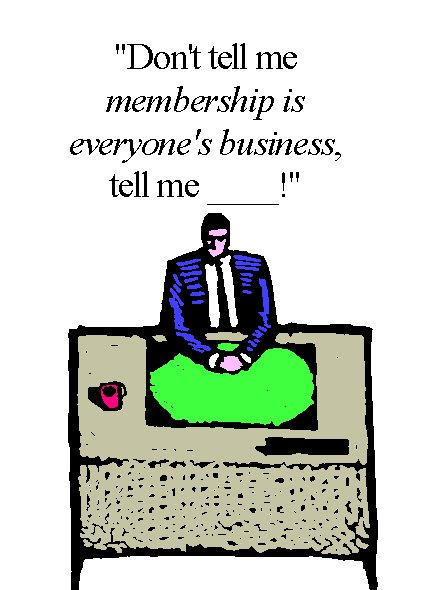
So let us modify the exercise to make it more relevant for a Membership Director. Imagine you’re having a conversation with someone from your Conventions Department. You’re trying to explain that “membership is everyone’s business” and he responds, “don’t tell me that, tell _____!” What does he need to hear from you? What will make the concept of “membership” relevant to him and his staff?

You can repeat this exercise for other departments:


The beauty of this exercise is that it helps you to think about membership from the perspectives of others, and that will make it easier to win their support. Good luck!

Thursday, January 27, 2011

What would Tony Soprano do?


Thanks to Anne O’Donnell and Cheryl Rothbart for leading the January 20th session of the Alexandria Brown Bag. One of the topics we discussed was how to engage the entire staff in the cause of membership.

What would Tony Soprano do?

Wouldn’t it be nice if membership was part of everyone’s job? In reality, trying to make this happen is a challenging, even daunting task. No doubt many membership directors have watched an episode of The Sopranos and fantasized being a bit like Tony Soprano. Hey, wouldn’t it be nice to swagger over to another department and declare, “it ain’t personal, it’s membership!”

Let’s face it, you’re not Tony Soprano; you can’t influence (i.e., intimidate) the way he does.  If you’re thinking about using him as a role model… fuggetaboutit!  Instead, here are some approaches that might work better and more safely:

Think cooperation and reciprocity: Here’s a great example: one Membership Director would offer editing services to other departments. It wasn’t part of her job and it was extra work. However, when it came time to ask other departments to help with membership-related activities, the basis for a cooperative and reciprocal relationship had been established. Instead of pleading for help, she was able to say, “My department helped you out with the editing, could you help us out with a membership-related issue?”

Be communal:  If you’re asking staff to call prospects, why not make it a fun and communal event? One association gathered staff in the Board Room, brought in pizza and made the effort a much more enjoyable task.  Free pizza and a party atmosphere is certainly more motivating that having to sit by yourself, at your desk, making phone calls.

Remember, sales isn’t for everyone: Not everyone is comfortable with cold calls to prospects or members. If someone is genuinely uncomfortable with this task, it’s best to find another membership-related task which is in their comfort zone. Give your colleagues a chance to help by doing what they do best.   

Focus on those who get it: The issue here is effective time management and a good ROI for the time you put in. Therefore, your efforts to engage other departments should concentrate on your colleagues who “get it” – those who believe that membership is truly the business of everyone on staff.  Take the time to find out who these people are and use their support as a stepping stone to win the support of other staff.

Monday, January 17, 2011

Quit Wasting Your Volunteers’ Talents

“Actually, I’m a member. I’m just doing this
until I find a volunteer opportunity that suits my talents.”


Is Your Association a Talent Wasteland?

“Do your members have talent?”

“Of course!” you are likely to respond. Okay, but let me ask this: “How are you utilizing those talents? How do you draw out the best in your volunteers?”  What would be your response?

Unfortunately, many associations fail to make good use of their members’ talent; volunteer opportunities are frequently a poor match for the talent pool – skills, experience and insights are wasted. To put it bluntly: some associations are a talent wasteland in regards to their members.

A Lesson from Great Managers

Let’s back up a moment and consider the results of a study by the Gallup Organization (as outlined in First Break All the Rules). They studied 80,000 managers in 400 companies to identify the characteristics of a great manager. This is what they saw in the great managers: 
  • When selecting someone, they select for talent, not simply experience
  • When setting expectations, they define the right outcomes, not the steps
  • When motivating someone, they focus on their strengths, not eliminating weaknesses.
  • When developing someone, they help him find the right fit, not just the next rung on the ladder.

Clearly, these lessons are relevant to volunteer management.


Catchafire.org – a different model

 What’s needed is the following shift in mindset about volunteers:


As an example, as well as inspiration, for how to put this new mindset to work, let’s look at the start-up website, Catchafire.org. Their tagline is, Changing the way people volunteer. Look at their Open Projects page; you will see the openings are listed in a way that attracts people based on their talents. This approach fits nicely with the findings of the Gallup study.

Is this how you go about recruiting volunteers in your association? If not, imagine a listing of volunteer opportunities on your association website, a la Catchafire.org, that targets your members by talent.

‘nuff said!

Related article: The Strength & Passion Interview