Showing posts with label membership. Show all posts

Tuesday, May 3, 2011

Could a Five-Minute Interaction with Members Boost Staff Productivity?

An intriguing question, eh? It came to mind after reading, Putting a Face to a Name: The Art of Motivating Employees

The article discusses a study involving paid employees at a call center for a public university; their duties included phoning potential donors to the school. As the authors note, "Employees...suffer frequent rejections from people unhappy about getting calls during dinner. Turnover is high and morale is often low. So how do you motivate workers to stay on the phone and bring in the donations? One relatively easy answer: Introduce them to someone who is aided by those dollars."

The study arranged for a five-minute session, where the employees could meet and interact with scholarship students who were the recipients of the school's fundraising efforts. The results were impressive: employees who had interacted with the scholarship students brought in vastly more money: a weekly average of $503.22, up from $185.94.

And this raises the question: should associations use a similar tactic? What if your association arranged, on a regular basis, for every employee to have a five-minute interaction, in-person or by phone, with a member who has benefited in a significant way from their membership (i.e., a member who has a positive and powerful story to tell)

What might be the pay-off in terms of morale and productivity?  

Tuesday, April 5, 2011

Want to Make Membership Everyone's Business? Call in the Marketing Subversives!


In two prior posts (What Would Tony Soprano Do? and Don't Tell Me Membership is Everyone's Business!), I discussed how to engage the entire staff of your association in the cause of membership. To further this cause, I will now discuss how to act as a Marketing Subversive.

The term comes from an article of the same name, Marketing Subversives (I highly recommend you download it). The author spent five years interviewing more than 1,000 managers in 30 companies. His goal was to understand how the certain managers were more successful in communicating and collaborating across departments and functions to achieve their marketing goals. Hmmm....seems to me some of these lessons might be useful in furthering an association's overall goal of recruitment, retention and member satisfaction.

Three Things Marketing Subversives Do

What is that subversives do? It comes down to three things:
  • They constantly work at organizing informal contacts among functions and departments?
  • They have a knack (or a charm or simply the persistence) for breaking through territorial defenses and organizational insularity.
  • They are savvy about knowing when and where to bend or break the rules.
The articles notes that "marketing subversives constantly analyze people's motivations" and seem to be constantly asking, "What do they really want?"  In other words, they are using a thinking process similar to that of the "Don't Sell Me ___, Sell Me ___" exercise discussed in Don't Tell Me Membership is Everyone's Business!

Furthermore, subversives build goodwill in their organizations by developing an exchange bank - "by doing favors for others,  they amass credits that can be traded for information or help." This is just another way of stating the principle of  "think cooperation and reciprocity" as outlined in What Would Tony Soprano Do?

The Bottom Line: Are you ready to become a marketing subversive?

Saturday, March 19, 2011

An Engaging Member Conversation

One of the key challenges for staff and volunteers is to engage members, especially new members, to help them find satisfying ways to participate in the association.

So let’s try a little test. 
Imagine you’ve just joined an association - as a “newbie” you’re trying to figure out what the association has to offer and whether to attend a meeting or get more involved in some other way. Which of these three approaches will most likely engage you?

THE "LAUNDRY LIST" APPROACH

"I will now describe every single program, benefit
and event the association offers!"


This laundry list” approach tends to be endemic among association staff who have developed the habit of reciting everything the association has to offer. It's like going to a restaurant, listening to the waiter recite a long list of specials, then feeling embarrassed when you ask to have the list repeated.


THE "IN YOUR FACE" APPROACH

"What? You haven't attended a meeting or served on a committee?"

This is an approach common to the long-time member (someone who has volunteered multiple times  to serve on committees, task forces and even the Board). He can't imagine why every member isn't doing the same. Alas, this approach is frequently off-putting - it has that "in your face" feel - to those who have neither the time nor inclination for such intimate involvement with the association.


THE "WE HAVE ALL SORTS OF MEMBERS" APPROACH

"We have all sorts of members who participate in different ways..."

With this approach, you begin the conversation by saying: "Some of our members don't have much time, so they're happy with our publications and participating on the listserv. Other members find they want to attend our annual meeting and some really enjoy making presentations. A smaller number of our members are more 'hands-on' - they like to serve on our various committees and special interest groups. Do any of these options appeal to you?"

This approach reassures the new member, making it clear there are a variety of "valid" ways to participate and benefit from the association. More importantly, it allows the member to feel comfortable with whatever option is chosen.

'nuff said!

Thursday, February 3, 2011

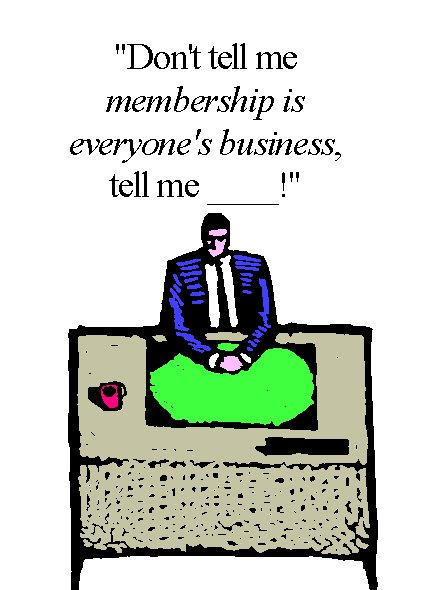
Don't Tell Me Membership is Everyone's Business!


In my previous post, I jokingly asked how Tony Soprano might engage the entire staff of your association in the cause of membership. In the interest of building harmonious relationships between the Membership Department and other departments, I would like to offer the following brainstorming exercise…

It’s called the “Don’t sell me _____, sell me ____!” exercise.  Begin by considering the following list:

Don't sell me clothes…...…....Sell me attractiveness

Don't sell me sneakers……….Sell me "airtime"

Don't sell me books………….Sell me knowledge

Don't sell me a lobotomy……..Sell me peace of mind

(FYI:  This if from Jumpstart Your Marketing Brain by Doug Hall)

The idea is to consider the real benefit or motivation for a product or service from the customer’s point-of-view. It is a powerful approach and one you can use inside your association to further the cause of membership.

 
So let us modify the exercise to make it more relevant for a Membership Director. Imagine you’re having a conversation with someone from your Conventions Department. You’re trying to explain that “membership is everyone’s business” and he responds, “don’t tell me that, tell _____!” What does he need to hear from you? What will make the concept of “membership” relevant to him and his staff?

You can repeat this exercise for other departments:


The beauty of this exercise is that it helps you to think about membership from the perspectives of others, and that will make it easier to win their support. Good luck!

Thursday, January 27, 2011

What would Tony Soprano do?


Thanks to Anne O’Donnell and Cheryl Rothbart for leading the January 20th session of the Alexandria Brown Bag. One of the topics we discussed was how to engage the entire staff in the cause of membership.

What would Tony Soprano do?

Wouldn’t it be nice if membership was part of everyone’s job? In reality, trying to make this happen is a challenging, even daunting task. No doubt many membership directors have watched an episode of The Sopranos and fantasized being a bit like Tony Soprano. Hey, wouldn’t it be nice to swagger over to another department and declare, “it ain’t personal, it’s membership!”

Let’s face it, you’re not Tony Soprano; you can’t influence (i.e., intimidate) the way he does.  If you’re thinking about using him as a role model… fuggetaboutit!  Instead, here are some approaches that might work better and more safely:

Think cooperation and reciprocity: Here’s a great example: one Membership Director would offer editing services to other departments. It wasn’t part of her job and it was extra work. However, when it came time to ask other departments to help with membership-related activities, the basis for a cooperative and reciprocal relationship had been established. Instead of pleading for help, she was able to say, “My department helped you out with the editing, could you help us out with a membership-related issue?”

Be communal:  If you’re asking staff to call prospects, why not make it a fun and communal event? One association gathered staff in the Board Room, brought in pizza and made the effort a much more enjoyable task.  Free pizza and a party atmosphere is certainly more motivating that having to sit by yourself, at your desk, making phone calls.

Remember, sales isn’t for everyone: Not everyone is comfortable with cold calls to prospects or members. If someone is genuinely uncomfortable with this task, it’s best to find another membership-related task which is in their comfort zone. Give your colleagues a chance to help by doing what they do best.   

Focus on those who get it: The issue here is effective time management and a good ROI for the time you put in. Therefore, your efforts to engage other departments should concentrate on your colleagues who “get it” – those who believe that membership is truly the business of everyone on staff.  Take the time to find out who these people are and use their support as a stepping stone to win the support of other staff.

Saturday, January 8, 2011

What would a "Membership Happiness Machine" look like?

A just-for-fun brainstorming exercise.

Watch this surprising, delightful video of a Coca Cola Happiness Machine. Now imagine what a Membership Happiness Machine would be. Good luck!

Saturday, December 18, 2010

The Case of the Myopic Membership Committee

I was Warned: “They’re Myopic!”

When I first started working with this particular membership committee, the Director of Membership sighed with much exasperation and declared, “Like most volunteers, they’re myopic.”

I asked her to explain.

“They just can’t see the big picture, membership-wise. They only seem to understand things in terms of what’s happened in their chapter – it’s a kind of nears-sightedness, if you will. The Chair is from San Diego and he wants to focus on a particular market segment that is significant in that region. What he’s suggesting makes sense for San Diego, but not in the context of a nationwide membership recruitment effort…”
 
Personal Experience is the Leading Cause of Volunteer Myopia

Volunteers are chosen to serve on committees for their experiences and their successes. That’s good. It can also be problematic because those experiences and successes are the lenses through which volunteers analyze and make decisions.

For example, put yourself in the shoes of a volunteer asked to serve on a membership committee. Let’s also assume that you’ve been chosen based on your local chapter’s success with a certain program (or targeting a specific segment). That success is probably the most significant learning event you’ve had in terms of membership development; it is the primary shaper of your thinking on the topic. Thus, it is only natural for you to think, “Hey, it worked in my chapter – it’ll work in every chapter.”

No wonder volunteers often have a tendency to be myopic; it is a natural outcome of their experiences. 

 Data is not the Cure for Committee Myopia

The Director of Membership had tried what seemed a logical approach. “I presented the membership data and research so they could see what was going on, not just in their chapter, but all over the country. They said they understood, but darned if they didn’t immediately revert back to their myopic ways; they keep insisting that what worked in their chapter applies everywhere.”  

Learning to See the Big Picture

The next time the committee met, I facilitated a different approach. I began the meeting by asking the committee to discuss their individual experiences in each of their chapters. I told them, “We are going to share our membership experiences and explore both the similarities and differences.” (By the way, the Director of Membership cringed when I did this).

After the committee members finished, I went to the flipchart and said, “We’re going to make two lists. The first list will be the major differences between your chapters. The second list will be the major similarities.” As we did this, the committee started to realize two things: 1) “What happens in my chapter isn’t necessarily representative of all chapters.”  2) At the same time, they saw a number of themes/issues that were common to a majority of chapters.

Next, the Director of Membership revisited the membership data and research with the committee. This time, they saw how their common themes and the key findings from the membership research dovetailed: for the first time they were starting to see the Big Picture. They were beginning to understand what their priorities, as the Membership Committee, ought to be; they were starting to see what strategies or programs were likely to yield the best bang for the buck.

There was a wonderful by-product of this process: it gave the Director of Membership her chance to shine as she guided the committee towards insights they would have otherwise missed. As a result, the committee had more confidence in her ability and a greater appreciation of her role as a qualified association professional. 

 The Importance of Getting In-Sync

The above process was based on a very simple principle used by high-performance organizations: investing the up-front time to get people “in-sync” pays off in the long run.

To recap:
  • The committee members were given the opportunity to get in-sync with each other by sharing experiences and comparing notes.
  • Building on that, the committee was better prepared to interpret the overall membership data and research. In other words, they were able to get “in sync” with the key facts and conclusions derived from that data and research.
  • A foundation for meaningful collaboration between staff and the volunteers was established (note: collaboration is defined as a shared act of discovery and accomplishment). In other words, the volunteers and staff had a process for getting in-sync with each other.

 The Chair Changes his Tune!

As a result of this discussion, the Chair changed his tune. He acknowledged that some of the lessons from his chapter in San Diego should not be applied to the association’s overall membership plan. He was able to see and appreciate and how priorities at the national level were different from those of his chapter.

 The Bottom Line

You want to set up your committees to succeed and that requires more than just providing them with the information they need to make good decisions: you need to help them get in-sync with each other. You also need to help staff get in-sync with the volunteers. Finally, you need to help volunteers make use of their experiences in a way that overcomes the dreaded “committee myopia.”