
Monday, February 25, 2013


Tuesday, January 22, 2013
Staying in Touch with the Board - What to Talk About
Staying in touch with the Board is obviously of great importance, whether via phone calls, email or other means. But what do we talk about? How do we support and improve board performance as well as enrich the experience of serving on the board? The answer lies in organizing your "staying in touch" efforts around three broad categories of information:
Information needed to conduct the Board’s business:
This includes the “usual suspects” such as Board minutes,
updates, etc. The important point here is to make sure there are no surprises
(i.e., Board members saying, “Why weren’t we told about this earlier?”).
In addition, you can stay in touch by offering your
reflections on what worked well at the last Board meeting and what could be
improved. Use this as the basis for an ongoing dialogue with Board members.
Information/knowledge that enhances a
person’s ability to serve on the Board:
Quite simply, an educated Board member is a better Board member. Use the process of staying in touch as an ongoing education program focusing on two areas. First, broadening and deepening the Board members’ knowledge of your organization (e.g., facts and insights about the membership) as well as the industry, profession or cause you represent. Second, you can develop a reading list of articles that serve as Food for Thought to provide new and strategic perspectives about the issues confronting your organization.
Information that enriches
collaboration among Board members and with staff:
Another way to stay in touch is to provide Board members the opportunity to share information about themselves, their experiences and their talents. Think of this as an ongoing Getting to Know You process. It lets them share stories and deepen relationships between Board meetings. This information will also help staff better understand and work with the Board.
And speaking of staff, consider providing a Getting
to Know Staff blurb as part of the staying in touch process. Highlight
staff expertise and accomplishments and give them the opportunity to offer
their expert opinion about issues facing your organization.
Related articles:
Thursday, January 17, 2013
Communicating Skillfully and Purposefully with Volunteers
 |
| Click here to download |
I have written this new guide for association staff. Let me know what you think.
Related articles:
- Dealing with Volunteers...It's a Tough Business!
- When Volunteers Gossip
- Finding the Confidence to Deal with Volunteers
- The Case of the Members Who Griped but Just Wanted to Help
- Get In Sync with Your Volunteers
Saturday, January 12, 2013
When Volunteers Gossip!
Gossip is more than idle chitchat. It can be very distracting,
demoralizing and a veritable time-suck. What to do when your volunteers
come to you with gossip, especially negative gossip, about other volunteers or staff?
From
the beginning, it should be made clear that gossip and the following
types of activities will not be tolerated in your organization.
- Talking about someone in a negative or critical manner when they are not present.
- Repeating hearsay information about another person (i.e., spreading a rumor).
- Violating a person's confidence by repeating information meant to be confidential.
This should be discussed, and ground rules should be established, during volunteer orientation or the first meeting of a board or committee.
Have a Shared Definition of Gossip
Make sure everyone, volunteers and staff, have a shared agreement on
what constitutes gossip. Take the time to discuss and develop a working
definition so there is no confusion on the topic. You can begin the
conversation by offering these criteria for evaluating whether someone
is engaging in gossip:
Is it fact or fiction? Has the person verified whether the information is true before passing it along?
What is the intent? Is the person spreading a rumor with the intent to harm another person's reputation? In what way does such information serve a useful purpose?
Does it honor the values of the organization? Is this person honoring the values of your organization when he talks (or sends an email, etc) in such a manner?
Make Sure People Know How to Respond to Gossip
Provide
training to staff and volunteers so they know how to spot and respond
to gossip. This includes specific behaviors such as what to say in a
face-to-face situation, how to handle an email, and to whom one should
report egregious acts of gossiping. In addition, make sure staff and
volunteers understand there will be consequences (e.g., volunteers can
be stripped of their positions and staff can face disciplinary
actions).
The Bottom-Line: The work of staff and volunteers is too important to be undermined by gossip. 'nuff said!
Related articles:
- Dealing with Volunteers...It's a Tough Business!
- Finding the Confidence to Deal with Volunteers
- The Case of the Members Who Griped but Just Wanted to Help
- Get In Sync with Your Volunteers
Thursday, January 10, 2013
Helping the Decision-Impaired Board
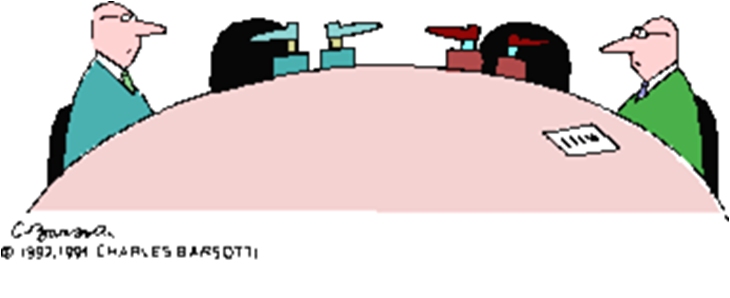
"I think we qualify as a decision-impaired board!"
Is your board decision-impaired? You may recognize the symptoms:
- A sense that the board is spinning its wheels and rehashing old issues.
- Heated discussions based on few facts but lots of opinions.
- Awkward moments when the board realizes it has lost track of the original topic.
- The frequent introduction of “wildcard” issues which were not originally on the agenda.
- An inability to explain to members why the board made a certain decision.
- A decision is ostensibly agreed to by the entire board but in reality not supported by every board member.
- A nagging feeling that decisions, when they are finally made, do not represent the best thinking of the board.
Is it possible for the decision-impaired board to improve? Take heart for
the answer is yes. Let’s look at how to target a board’s competency in
decision-making:
Step 1 – Self-Assessment:
In order to improve, the board will first need a framework for
understanding its overall strengths and weaknesses during group decision-making. It
needs to answer three basic questions:
- How do individuals in the group prefer to make decisions, process information and set priorities? What are respective strengths and weaknesses of the individuals in the group?
- In what ways do these differences in individual styles lead to either to conflict or harmony among the board.
- What is the group’s overall strengths and weaknesses? Is there a balance of different decision-making styles or is the group top-heavy in one area but not another?
What is the best way to assess the board? The Leadership Spectrum Profile®.
The profile identifies six types of priorities a person is likely to favor and
how that priority influences his or her decision-making process:
Leadership
Spectrum Profile
|
||
Priority
|
Actions
|
|
Inventor
|
Innovation and survival
|
Develop new ideas, products and
services
|
Catalyst
|
Fast growth
|
Gain market share and win customers/new members
|
Developer
|
Manage risk and
establish order
|
Build infrastructure, create systems and processes
for high performance
|
Performer
|
Maximize results
|
Improve processes and procedures for effective
resource utilization and
return
|
Protector
|
Maintain success
|
Develop committed workforce, build capabilities, &
support culture/identity
|
Challenger
|
Position for the future
|
Surface assumptions, practices, and issues; and
create strategic options
|
©
1998-2002. The Leadership Spectrum Profile®. Enterprise Management Ltd. All Rights Reserved
|
||
Using the Leadership Spectrum profile, one decision-impaired board found all its board members were Challengers or Inventors. From the standpoint of developing strategy, this was a definite plus, as the association needed to position itself for future.
From an operational standpoint, however, the board was very
weak and this was reflected in its chronic inability to make timely and sound
decisions. In fact, the association was in jeopardy due to financial
difficulties. The board realized it had no individuals who were strong as Developers or Performers. As a consequence, the board paid little attention was
paid to metrics for or processes to improve its performance.
With this
realization, it became clear why good decisions about operational issues were hard to come by.
The board responded by saying, "Okay, when it comes to issues of performance
and board development, we have to slow down, take the time to ask the types of
questions a Developer or Performer might ask. In that way we can compensate for
our weaknesses in those areas.”
To recap, using the Leadership Spectrum Profile provides a framework so the board understands how to:
- Balance strategic and operational decisions.
- Lead and implement change.
- Develop credible and constructive communication practices.
- Manage conflict and facilitate creative problem solving .
Step Two – Establish
Guidelines for Effective Decision Making:
Once a board understands its strengths and weaknesses in
decision-making, it needs a practical set of guidelines and processes. The following set of questions, which represents the
steps to sound decision-making, are the basis for those guidelines.
| IS THIS A BOARD PRIORITY? Is this issue a priority for the association and for the board? If so, why? Is the board meeting the best venue for addressing this issue? Or can it be addressed in another venue? |
| # |
| WHAT IS THE OBJECTIVE? What is the goal or objective? What is the board trying to accomplish by making this decision? Have we clarified the problem or issue? What is the problem that really needs to be focused on? Does everyone agree we that we have a well-defined problem statement? |
#
|
| WHAT ARE THE FACTS? What's the situation or background? Does the board have all the facts it needs to begin the discussion or should we table the discussion until more information is gathered? |
#
|
| WHAT ARE THE DECISION OPTIONS? What are all the possible decision we might make? Which ones are most feasible or on-target? |
#
|
| WHAT ARE THE CRITERIA? Before we begin making a decision, have we identified and agreed to the criteria we will use to make our decision? |
#
|
| WHAT IS THE DECISION-MAKING PROCESS? Are we clear how the group will go about making a final decision? Is it consensus? Majority vote? Another methodology? |
Step Three –
Practice!
It is not sufficient to ask the Board to read an article or
provide a fifteen minute presentation on decision-making skills. This rarely improves board performance. The fastest, most effective path to
improved decision-making is hands-on training; the Board should
set aside time so it can practice – go through the process of applying specific
skills and guidelines so they understand the practical applications and
benefits. I have seen Boards, as a result of a day of practice, make dramatic
improvements.
In conclusion, I would like emphasize the following: if you
want to improve the decision-making capabilities of your board, you need to
invest the time for skills training and hands-on practice.
Thursday, December 13, 2012
The Wrong Way to Recruit Volunteers
Here's the wrong way to recruit volunteers.
The Three Golden Rules of Volunteer Recruitment
Instead, consider The Three Golden Rules of Volunteer Recruitment:
'nuff said!
Related articles:
Step One: Post the Following Announcement: We are looking for volunteers to serve on the XYZ committee. Please Join.
The problem with this approach is, quite simply, a lack of quality control.
Step Two: Take all comers.
The Three Golden Rules of Volunteer Recruitment
Instead, consider The Three Golden Rules of Volunteer Recruitment:
- Make clear the "stakes of winning." People are motivated by meaningful challenges. Take care to articulate why a particular volunteer assignment constitutes a challenge that deserves a member's personal time and commitment (i.e.., it's not just a committee assignment, it's an adventure!).
- Carefully match the strengths/talents/experiences of the volunteers to the nature of the assignment. Research on performance in the workplace shows the importance of matching people's strength to the tasks they are assigned. The same is true for volunteers.
- Be prepared to spend the time necessary to get the right volunteers. Think "Return on Investment" - the time you spend on this will pay off in good work.
And here's a final idea: consider asking prospective volunteers to submit proposals on why they would be a good fit for the assignment. It sends a message that you are expecting great things from your volunteers.
'nuff said!
Related articles:
- Dealing with Volunteers...It's a Tough Business!
- Finding the Confidence to Deal with Volunteers
- The Case of the Members Who Griped but Just Wanted to Help
- Get In Sync with Your Volunteers
Subscribe to:
Posts (Atom)